Materials & the life of things
From Fiber to Second Use: Coyuchi Throws and Textile Circularity
A recycled-cotton blanket can tell a useful story about what happens after the first life of a textile. It can also remind us that reuse is a beginning, not a magic trick.
A blanket has a way of seeming exempt from the ordinary laws of consumption. It is not eaten, worn through in a season, or easily lost behind a sofa—though all three things can happen. It is folded at the end of the bed, brought out for a cold evening, carried from room to room, and eventually, perhaps, placed in a bag marked for donation. Its life looks simple from the outside. Inside the fabric, the story is more complicated: agricultural land, water, processing, dyeing, weaving, transport, use, washing, and the question of what becomes possible when the blanket is no longer wanted.
Textile circularity begins with that last question, but it does not end there. The idea is to keep materials useful for longer—by maintaining, repairing, reusing, reselling, or recycling them—rather than treating every finished object as a one-way journey from raw material to disposal. In practice, circularity is less a perfect loop than a set of imperfect turns. Fibers can be recovered, but often with limitations. Products can be designed to last, but no design can guarantee that a household will keep them. And a recycled label, while meaningful, cannot tell the whole environmental story on its own.
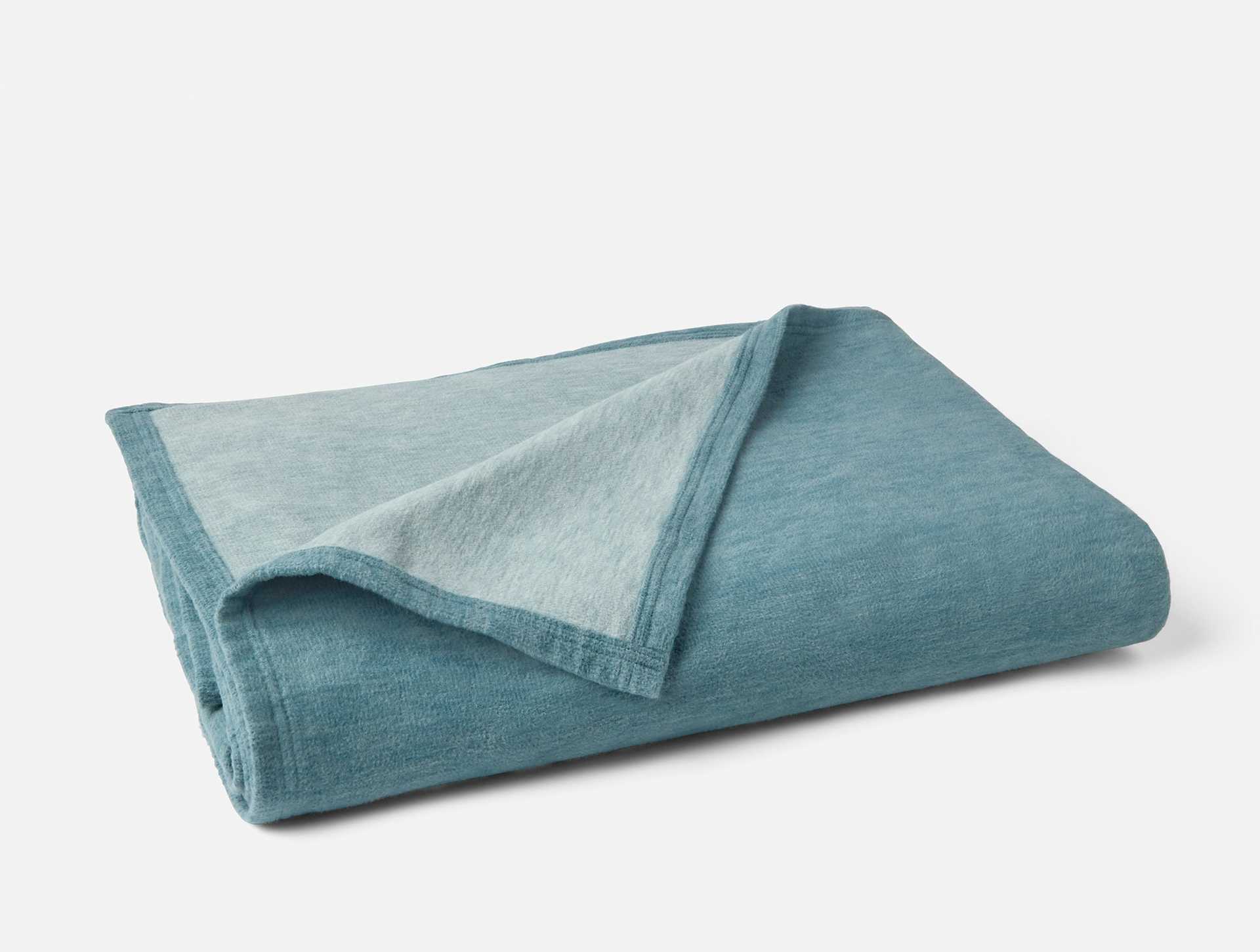
Coyuchi’s Full Circle Recycled Cotton Blanket makes a clear case study of one of those turns. Its listed composition is 52 percent recycled cotton from Coyuchi’s 2nd Home program and 48 percent organically grown cotton. Woven in Germany, it has a brushed finish; the recycled yarn contributes natural variations in color. The product description also identifies it as GRS certified, a certification associated with verification of recycled content and supply-chain requirements. The blend places old cotton and newly grown cotton together in a new object—not a closed loop, exactly, but a visible effort to keep some material in circulation.
What “recycled cotton” means—and what it leaves unsaid
Cotton begins as a plant fiber, but the cotton in a finished textile has already passed through a small industrial epic. It may have been spun into yarn, dyed, woven or knitted, sewn, shipped, used, washed, and discarded. Recovering cotton from an existing product or textile waste can reduce demand for virgin fiber in a new product. It can also give material that might otherwise be thrown away another role. That is a practical proposition, and a potentially important one, especially when the recovered material displaces the use of new resources rather than simply adding another item to an already crowded market.
But “recycled” describes a material pathway, not a universal environmental score. The impacts of a textile depend on many things: the source and condition of the recovered fiber, the processes used to sort and prepare it, the energy and water involved in manufacturing, the other fibers in the blend, the product’s useful life, and its eventual end of life. Those details vary. A recycled-content claim does not, by itself, establish that a product has a smaller footprint in every category, nor does it mean that making and shipping it has no environmental cost.
That distinction is worth holding on to. Circularity can be a real improvement without being a claim of perfection. It is possible to value the recovery of existing cotton and still ask where it came from, how much is present, how it is documented, and what will happen to the finished textile after years of use. The point of careful scrutiny is not to make every ordinary object suspicious. It is to replace the soothing vagueness of “eco-friendly” with questions that have answers.
In the Full Circle blanket’s case, the product information gives a percentage breakdown: 52 percent recycled cotton and 48 percent organic cotton. That accounting matters because it gives the reader something more specific than a general assertion of sustainability. The description says the recycled cotton comes through the brand’s 2nd Home program and identifies GRS certification. For a shopper evaluating a claim, this kind of detail is more useful than a green-colored label or a phrase that gestures toward nature without explaining the material.
The difficult business of making fibers go around
Textile recycling is not as simple as melting down a glass bottle and making another. Fabric is made from fibers spun into yarns and assembled into structures; it may also include dyes, finishes, sewing thread, trims, and blends of different materials. These features can make separation and recovery difficult. Cotton itself can be mechanically processed into fiber again, but the recovered strands may be shorter than the original ones. Shorter fibers can be harder to spin into strong, fine yarn, so recycled cotton is often blended with longer fibers or used in applications where its properties are suitable.
That is one reason blends require attention. A mix of recycled and organic cotton can make sense as a way to combine recovered material with additional fiber for a new textile. Yet blends can complicate later recycling, because a future processor may have to deal with fibers that are not all identical. The precise challenge depends on the materials and the available processing systems; there is no single rule that applies to every blend. Still, an object made from multiple fiber types may be more difficult to return to clean, separable feedstock than one made from a single material.
In this instance, the stated blend is cotton with cotton, rather than cotton combined with a different fiber such as wool or polyester. That fact may be relevant to future recovery, but it does not guarantee that the blanket can be recycled again. Construction, dyes, finishes, contamination, local collection systems, and the capacity of recycling facilities all matter. The word “cotton” on a label cannot compel a recycling route to exist. Material compatibility is only one part of the puzzle; infrastructure is another.
For this reason, the best version of circularity is not necessarily the one with the most dramatic label. It is the one that considers the whole journey: whether the product is made to be used for a long time, whether it can be cared for without undue difficulty, whether its components are understood, and whether a credible recovery option exists when use is truly over. Even then, the hierarchy matters. Keeping a blanket in use—by using it, repairing it, handing it to someone else, or donating it where appropriate—can preserve its value before any recycling process is considered.
A second use is a form of design
The phrase “second use” can sound modest. It is not the grand language of technological rescue; it describes a textile continuing to do what textiles do. A blanket covers, warms, cushions, and travels. When the first owner no longer needs it, another person may find it useful. The material has not been transformed into something new, but the object has acquired more time. In environmental accounting, that extra time matters because a durable product used longer may reduce the frequency with which a replacement must be made. The effect depends on what it replaces and how it is used, but the underlying principle is plain: longevity is a resource strategy.
Design can support that strategy through a construction that withstands ordinary life, a familiar form that does not depend on a passing trend, and care instructions that people can realistically follow. The Full Circle blanket’s description emphasizes a brushed finish and a construction intended to withstand regular wash and wear. It specifies cold machine washing, a gentle cycle with like colors, and low-temperature tumble drying. These instructions do not amount to a guarantee of indefinite life. They do, however, make maintenance legible, which is a practical virtue. A textile is easier to keep if its owner knows how to look after it.
Care is not merely a household chore appended to the end of a product page. It is part of a textile’s environmental story. Frequent hot washing, excessive detergent, high heat, and rough handling can put stress on fibers and finishes. Washing only when needed, following the care label, and avoiding unnecessary high temperatures can help preserve a textile. So can prompt attention to a loose thread or a small tear. A repair does not have to be invisible to be effective; sometimes the neatest thing a blanket can wear is evidence that it has been kept.
There is also a quieter virtue in buying less often. A new blanket made with recycled fiber is still a new blanket. If it fills a genuine need and is used for years, its material choices may be part of a considered decision. If it is purchased because the presence of recycled content makes additional consumption feel costless, the arithmetic becomes less persuasive. Circularity is not an excuse to ignore volume. It is a way to think more carefully about materials and use, not a permission slip for endless replacement.
How to read a circular textile claim
When considering a recycled-cotton throw or blanket, a few questions help distinguish useful information from broad atmosphere. The first is simple: What share of the product is recycled? A percentage tells a more precise story than “made with recycled materials.” The next question is what the remaining fiber is. In the Full Circle design, the listed balance is organic cotton; other products may use different materials, each with different implications for care and future recovery.
Then ask how the recycled content is verified. Certifications can offer a framework for auditing claims and supply-chain requirements, though the scope of any certification should be checked rather than assumed. The Full Circle description identifies GRS certification. That is a more concrete point of reference than an unexplained assertion, but it does not answer every question about total environmental impact. No single certification should be treated as a summary of a product’s entire life cycle.
Construction and care come next. Is the textile made for regular use? Are washing instructions clear? Are the seams and edges likely to tolerate the way the item will actually be used? The answers are not always apparent from a product description, and care guidance cannot substitute for durability testing. Even so, these are worthwhile questions because the years a product remains useful are part of its performance, not an afterthought.
Finally, consider the exit route. Can the textile be repaired, passed along, donated, or taken back through a reuse program? Does the maker provide a defined pathway, and what happens to items once collected? A take-back scheme can help, but its presence alone does not prove that every returned item becomes a new product. Collection, sorting, resale, recycling, and disposal are distinct steps. A transparent program should make clear what it accepts and how the material is handled.
- Look for proportions: identify the percentage of recycled fiber and the composition of the rest.
- Check verification: note any named certification and what it is intended to verify.
- Think about useful life: assess whether the item fits your needs and whether its care instructions are manageable.
- Ask about the next step: reuse and repair may come before recycling, and the available route depends on location and program rules.
The everyday scale of environmental responsibility
Environmental debates often favor the spectacular: a novel material, a new machine, a policy announced beneath a bright lectern. Textile circularity is less theatrical. It depends on systems that can identify material, collect it, sort it, process it, and send it somewhere useful. It also depends on people treating objects as objects with a future rather than as temporary scenery. The work is distributed across manufacturers, retailers, waste systems, and households; no one participant can close the loop alone.
This is why one recycled-cotton blanket should neither be asked to redeem an industry nor dismissed for failing to do so. It can show what a specific material choice looks like in a finished product. It can make the proportion of recycled content visible. It can offer a prompt to think about durability, washing, and what happens after use. What it cannot do is establish that the entire textile economy is circular, or that recycling has solved the resource demands of making cloth.
There is a useful difference between a product story and a system story. The product story concerns the fibers and construction of an individual blanket. The system story asks whether the collection and processing networks exist to recover textiles at scale, whether recovered fibers can meet manufacturing needs, and whether business models reward longevity as much as new sales. A well-documented product can be part of a larger transition, but it is not evidence that the transition is complete.
Nor does responsible use begin with the purchase. It begins with a question that can seem almost disappointingly unromantic: Do I need this? If the answer is yes, then material composition, origin, care, and durability deserve attention. If the answer is no, buying a recycled item is still buying an item. The most circular textile may sometimes be the one already in the cupboard, the one repaired at the edge, or the one passed on instead of replaced.
Keeping the story open
The Full Circle Recycled Cotton Blanket offers a tangible illustration of fiber reuse: 52 percent recycled cotton from the 2nd Home program, 48 percent organic cotton, a brushed finish, German weaving, and a stated GRS certification. Those details give the conversation something solid to rest on. They describe a material choice and a manufactured object, not a verdict on every aspect of its footprint.
The more important story is what happens around the object. A blanket kept in service for years, washed with care, mended when necessary, and eventually passed to another user has a longer chapter than one bought, briefly admired, and discarded. Recycled content can help keep fiber in use; longevity can delay the moment it must be recovered again. Neither makes the other unnecessary. Together, they suggest a more realistic ambition than perfection: make fewer things wasteful, let useful things remain useful, and design the next chapter before the last one arrives.
Textiles are ordinary enough to escape our notice and material enough to deserve it. Cotton passes through fields and mills before it settles into the domestic landscape, where it becomes a familiar weight across a bed or shoulders on a cool evening. Circularity asks us to notice the journey without pretending we can make it frictionless. A second use is not the end of the story. It is simply a reason to keep reading.