Nursery textiles · Materials & care
Why Waffle Weaves Work Well in Naturepedic Nursery Textiles
A grid of raised cotton cells can make a blanket feel airy, tactile, and substantial all at once. In a nursery, those qualities matter—but so do the ordinary questions of washing, layering, and using textiles safely.
Some fabrics announce themselves at a glance. A waffle weave does so by refusing to lie entirely flat. Its raised ridges and recessed squares form a small landscape across the cloth: orderly, repetitive, and faintly architectural. Pick it up and the pattern becomes more than decoration. It gives the surface texture, a little spring, and a different sense of weight from a smooth, tightly woven sheet.
That combination helps explain the appeal of waffle fabric in nursery textiles. A blanket made this way can feel cozy without appearing dense, and the spaces in its construction can give air a route through the cloth. Those features are useful to understand when choosing an everyday layer for a baby’s surroundings. They do not, however, make any blanket a substitute for safe-sleep guidance. Texture is a matter of comfort and design; sleep safety is its own essential subject.
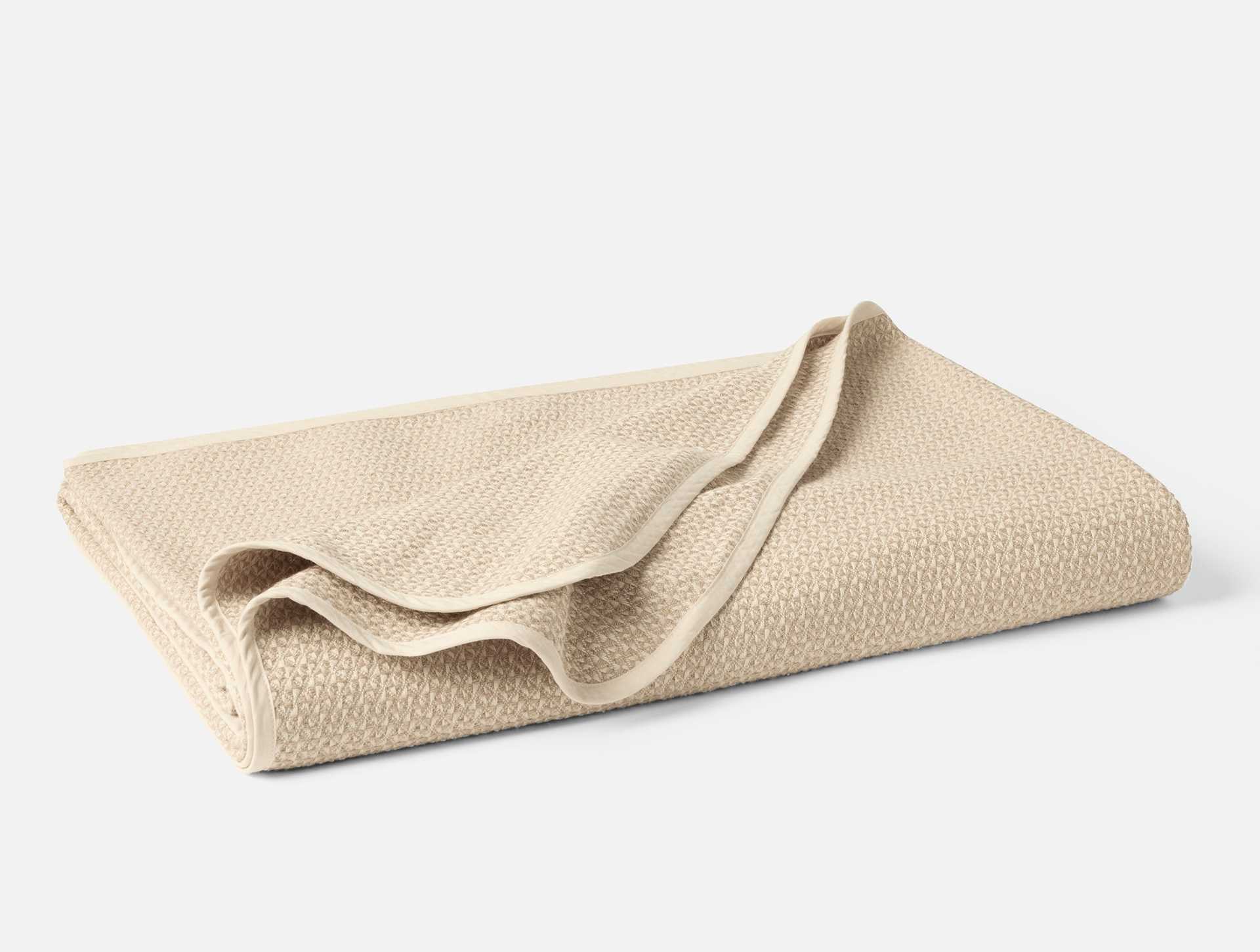
The Naturepedic Organic Cotton Waffle Baby Blanket offers a practical example. It is described as a lightweight blanket made from GOTS-certified organic cotton, with a raised waffle weave, a size of approximately 30 by 40 inches, and machine-washing instructions. Looking closely at those details is a useful way to explore how weave, fiber, construction, and care shape the everyday experience of nursery fabric.
A weave that builds its own texture
Waffle cloth is named for its resemblance to the familiar grid of a breakfast waffle, though the comparison is chiefly visual. In a woven textile, the pattern comes from the arrangement of threads: some areas sit higher, while neighboring areas recede. The resulting cells create a surface that is neither sleek nor heavily piled. Light catches the raised parts; the small depressions lend the fabric its characteristic depth.
That structure changes how a blanket feels in the hand. A smooth plain weave presents a relatively even surface, while waffle fabric offers a sequence of tiny ridges and hollows. The texture can feel pleasantly dimensional against the fingers, without relying on a thick, fuzzy nap. For a baby, it may also make a blanket an interesting object to explore during supervised, awake moments. That is a modest sensory quality, not a developmental claim: a textured fabric is simply a different tactile experience from a flat one.
Construction also influences a textile’s appearance after it is folded or draped. Waffle weaves tend to show their pattern clearly in changing light, and their surface can look softly puckered rather than crisp. In a nursery, that makes the blanket feel at home in both practical and decorative roles: folded in a basket, carried in a stroller, or used as a comfortable layer during supervised floor time. A fabric’s charm, in other words, is partly a consequence of the way its threads are organized.
Why an open-looking structure can feel breathable
Breathability is often discussed as if it were a single quality, like a color or a fiber label. In practice, it depends on several things: the fiber, the yarn, the density of the construction, the thickness of the finished fabric, and the conditions in which it is used. A raised weave can create more surface area and leave small spaces around its cells. That may help a lightweight blanket feel less solid and allow air to move through it more readily than a thick, compact fabric.
It is tempting to turn that observation into a promise that a particular textile will keep a baby at a perfect temperature. That would say too much. A blanket’s performance depends on the room, the layers beneath it, the wearer, and how the item is being used. The useful, grounded distinction is simpler: waffle fabric often combines a tactile, cozy surface with a construction that does not feel as uniformly dense as some heavier weaves.
For grown-ups arranging a nursery, this can make the blanket versatile across ordinary settings. A light cotton layer may be easier to fold into a bag than a bulky throw, and the textured surface can feel inviting without requiring a plush pile. But no textile should be treated as a temperature-control device or as a reason to add bedding to an infant sleep space. For sleep, follow current advice from a pediatrician and recognized safe-sleep authorities. A blanket’s weave does not change those recommendations.
Organic cotton is a fiber story, not a safety shortcut
Fiber content is one of the first details shoppers notice, and cotton has particular familiarity in nursery settings. It is soft, widely used, and generally straightforward to launder according to a product’s care label. In a waffle blanket, cotton yarns form the patterned structure, so the hand of the finished cloth reflects both the fiber and the weave. The same cotton can feel quite different when it is woven smooth, looped into terry, or shaped into raised cells.
The Naturepedic blanket is described as made from GOTS-certified organic cotton. Organic certification concerns standards for the production and processing of textile materials; it is meaningful information about how a product is made. It should not be mistaken for a blanket’s complete safety assessment, nor does the word “organic” alone establish that an item is appropriate for every use. Parents can consider certification alongside construction, care instructions, and the guidance that applies to the child’s age and setting.
It is also worth distinguishing material preference from a medical claim. Choosing cotton may suit a family’s priorities around feel, laundering, or sourcing. It does not guarantee that a child will never experience irritation, and it is not a treatment for skin conditions. If a baby has sensitive skin or a known allergy, caregivers should seek individualized advice from a qualified health professional and check the full product information.
The everyday case for a lightweight baby blanket
A nursery blanket is often less a grand furnishing than a useful companion to routine. It may be folded into a diaper bag, brought along for a stroller outing, spread down for supervised play, or kept close for a cuddle while an adult is present. In those moments, weight and portability matter. A blanket around 30 by 40 inches is a manageable size for carrying and folding, though actual fit and use will depend on the setting.
The waffle construction contributes a particular balance: enough texture to feel like a distinct textile, but without the bulk associated with some heavily napped or padded blankets. The grid can also make the fabric visually interesting in a way that does not depend on a bold print. That restraint suits a nursery where textiles may need to coexist with patterned sheets, toys, and all the other objects that accumulate around a small person.
It is equally important to name what the blanket is not. A baby blanket should not be placed in an infant’s sleep space if current safe-sleep guidance advises against loose bedding there. The U.S. Consumer Product Safety Commission and the American Academy of Pediatrics provide public guidance on infant sleep safety; caregivers should consult current recommendations and their child’s health professional. A product’s softness, breathability, certification, or intended nursery use does not override safe-sleep practices. During awake time, use the blanket only in an age-appropriate, supervised way.
Care: the quiet test of a good textile
Nursery fabric has a life beyond the first impression. It is handled, folded, washed, and returned to service. A blanket that looks lovely but demands elaborate maintenance may prove less useful than one whose care routine fits naturally into a household. The Naturepedic waffle baby blanket’s listed instructions are straightforward: machine wash warm, tumble dry low, do not iron, and do not bleach. Following the care label is the simplest way to help preserve the fabric’s feel and appearance.
Waffle texture can change subtly with laundering. Cotton may relax or become softer through use; the raised pattern may appear more or less pronounced depending on how the cloth is dried and handled. That is not necessarily a defect. Textiles are not inert surfaces: washing, heat, friction, and time all affect their hand. Low tumble-dry settings and avoiding bleach, as specified for this blanket, provide a practical starting point. When in doubt, the product label takes precedence over broad assumptions about cotton.
Routine care also means treating stains promptly and washing with similar items when appropriate, while taking care not to overload the machine. Detergent preferences vary by household and skin sensitivity, so there is no universal formula. The useful principle is to follow the maker’s instructions and avoid adding treatments the product does not call for. A well-kept blanket is not one that remains untouched; it is one that can be cleaned and returned to its everyday role without unnecessary fuss.
Waffle, muslin, and smoother weaves
Comparisons help make the qualities of waffle fabric easier to see. A smooth, plain-woven cotton blanket typically has a flatter surface and a more uniform feel. Muslin, often made with a light, open construction, is known for its airy character and gently crinkled appearance. Waffle weave sits somewhere else in the sensory landscape: it has a pronounced pattern and a more dimensional hand, while remaining relatively light when the fabric itself is not heavily built.
None of these structures is universally better. A family might prefer a smooth weave for its clean drape, muslin for its lightness, or waffle for its texture and visual depth. Warmth depends on more than the name of the weave; fiber, thickness, density, and the number of layers all matter. Likewise, a product described as breathable should not be interpreted as safer for unsupervised infant sleep. The most reliable choice is the one that suits the intended, age-appropriate use and can be cared for consistently.
These distinctions are useful for adults shopping with a specific question in mind. Is the priority a compact layer for travel? A surface with tactile character? A blanket that can be machine-washed? Considering those practical needs can make product descriptions less abstract. “Waffle” identifies a construction; it does not answer every question about weight, dimensions, durability, or safe use. Those details deserve their own attention.
Reading a product description with care
When evaluating nursery textiles, it helps to separate what a description states from what a reader might infer. For the Naturepedic waffle baby blanket, the relevant stated details include its organic cotton composition, waffle construction, approximate 30-by-40-inch dimensions, machine-wash instructions, and one-year warranty. Those facts offer a useful outline of the product. They do not establish how every child will respond to the fabric or determine whether a particular use is appropriate.
Look for the information that affects everyday decisions: fiber composition, size, washing and drying instructions, and any applicable certification. If a description emphasizes breathability or softness, read that as a design characteristic rather than a medical guarantee. If it suggests multiple uses, consider each one separately, especially where infant sleep is concerned. A blanket can be convenient for supervised awake-time activities and still be unsuitable for an unattended sleep environment.
It can also help to think about the blanket’s place in a broader nursery routine. Will it be carried outside the home? Is its size manageable for the intended use? Can the household follow the wash instructions? Does the texture appeal to the family? These are unglamorous questions, but they often matter more than a color name or a carefully staged room. A textile earns its keep through repeated use, not merely through its first appearance.
A small architecture of comfort
The waffle weave’s appeal lies in its modest ingenuity. Threads form a repeating grid; the grid gives the cloth relief; the relief makes a familiar material feel newly tactile. In the nursery, that structure can offer a lightweight, machine-washable layer with a little more personality than a flat weave. Organic cotton and a clear care label add useful context for families considering how a blanket is made and maintained.
None of those qualities needs to be exaggerated. A waffle blanket is not a cure for poor sleep, a guarantee against overheating, or a replacement for safe-sleep advice. It is a piece of fabric, and a thoughtfully constructed one can be valued for what fabric does well: soften a routine, accompany an outing, and make an ordinary surface more interesting to the touch.
Seen this way, the Naturepedic Organic Cotton Waffle Baby Blanket is less an argument about the perfect nursery than an example of how textile choices work in real life. The weave offers texture. Cotton provides the fiber. Care instructions make maintenance legible. And responsible use begins with a clear boundary between a comfortable blanket and the separate, non-negotiable guidance that protects infant sleep. The distinction is simple; keeping it in view is part of caring well.